

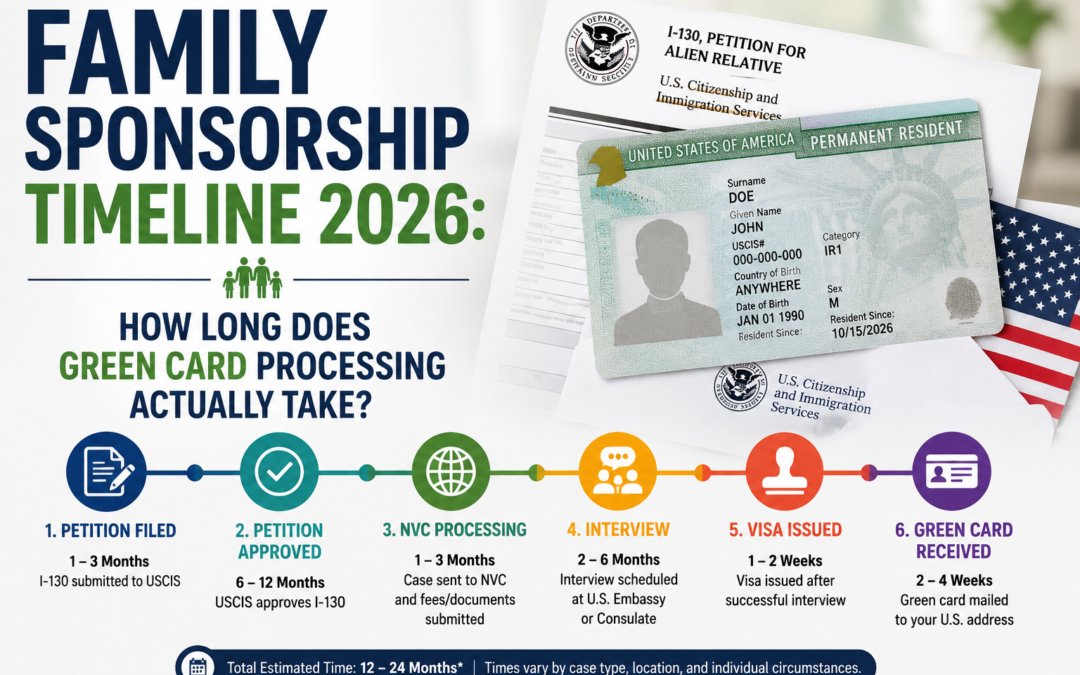
Bringing a spouse, parent, child, or other qualifying family member to the United States can be a lengthy process, and one of the first questions families usually ask is: How long will it take to get a Green Card?
There is no single family sponsorship timeline that applies to everyone. Processing can depend on the family relationship, whether the petitioner is a U.S. citizen or lawful permanent resident, the beneficiary’s location, visa availability, and whether the case proceeds through Adjustment of Status or Consular Processing.
In 2026, it is also important to distinguish between USCIS processing time and the overall immigration timeline. For example, USCIS reported a FY2026 median processing time of 12.9 months for immediate-relative Form I-130 petitions through May 31, 2026. But an approved I-130 does not automatically give the beneficiary a Green Card or permission to immigrate.
How Long Does Family-Based Green Card Processing Take in 2026?
The answer depends largely on which family-based immigration category applies to your case.
Some family members of U.S. citizens are classified as immediate relatives. This includes:
- Spouses of U.S. citizens
- Unmarried children under 21 of U.S. citizens
- Parents of U.S. citizens who are at least 21 years old
For these immediate relatives, immigrant visas are generally immediately available once the qualifying petition is approved.
Other relatives fall into family preference categories. These include certain adult children, spouses and children of lawful permanent residents, married children of U.S. citizens, and siblings of U.S. citizens. Because these categories are subject to annual numerical limits, families may have to wait for a visa number to become available.
This means that an I-130 approval is an important milestone, but it does not necessarily mean the beneficiary can immediately complete the Green Card process.
Why Family Sponsorship Timelines Vary
Two families can file similar immigration petitions and experience very different timelines. Several factors can influence how quickly a case moves forward:
- Family relationship: The category that applies to a spouse may differ from the category that applies to an adult child or sibling.
- Petitioner’s status: A U.S. citizen and a lawful permanent resident do not have identical family sponsorship options.
- Priority date: Family preference cases generally depend on the beneficiary’s place in the visa queue.
- Visa availability: A visa must be available before certain family preference cases can move forward.
- Beneficiary’s location: Someone applying from inside the United States may follow a different process from someone living abroad.
- USCIS processing: The time required to review and decide petitions and applications can vary.
- Case-specific issues: Requests for Evidence, missing documents, interviews, background checks, or immigration complications can add time.
For family preference immigration categories, the priority date is particularly important. USCIS explains that the priority date generally corresponds to when the properly filed I-130 petition was submitted and is used to determine a beneficiary’s place in line for visa availability.
Because processing times and visa availability can change, a family should look at its specific category and current Visa Bulletin rather than relying on a single estimated number of months.
The I-130 and Visa Availability Stages
Once you understand which family-based category applies to your case, the next question is how the process actually moves forward. For most family-sponsored Green Card cases, the process begins with a Form I-130, Petition for Alien Relative. However, an approved I-130 is only one milestone.
Depending on the family relationship, the beneficiary may still need to wait for an immigrant visa to become available before moving to the final stage.
Step 1: Filing the I-130 Petition
The I-130 petition is generally the starting point for family-based immigration. The U.S. citizen or lawful permanent resident petitioner files the petition to establish a qualifying family relationship with the beneficiary.
The petition typically requires evidence showing both the petitioner’s immigration status and the family relationship. Depending on the relationship, this may include marriage certificates, birth certificates, divorce records, proof of a bona fide marriage, or other supporting documentation.
USCIS reported a 12.9-month median processing time for immediate-relative I-130 petitions in FY2026 through May 31, 2026. Actual processing can vary depending on the case and USCIS workload.
It is also important to understand that I-130 approval does not by itself give the beneficiary a Green Card. It establishes the qualifying relationship and, for preference categories, generally establishes the priority date used in determining when a visa may become available.
Step 2: Waiting for Visa Availability
After the I-130 is filed, the timeline can look very different depending on the family category.
For immediate relatives of U.S. citizens, immigrant visas are generally available without the numerical limitations that apply to family preference categories. This can allow an eligible beneficiary to move forward once the other requirements are satisfied.
Family preference cases work differently. These categories are subject to annual numerical limits, meaning families may have to wait until an immigrant visa becomes available.
The U.S. Department of State publishes a Visa Bulletin each month showing visa availability for these categories. s
The major family preference categories include:
- F1: Unmarried adult sons and daughters of U.S. citizens
- F2A: Spouses and unmarried children under 21 of lawful permanent residents
- F2B: Unmarried adult sons and daughters of lawful permanent residents
- F3: Married sons and daughters of U.S. citizens
- F4: Brothers and sisters of adult U.S. citizens
The wait can be substantially different from one category to another. Your country of chargeability can also affect visa availability because the Visa Bulletin provides separate dates for certain countries with higher demand.
What Is a Priority Date?
Your priority date is essentially your place in the visa queue for a family preference case. For family-sponsored immigrants, USCIS generally considers the priority date to be the date the properly filed Form I-130 was received.
You can then compare that date with the applicable date in the Visa Bulletin to determine whether your case has reached the point where the next stage can move forward.
It’s important to remember that “I-130 approved” and “visa available” are not necessarily the same thing. A petition can be approved while the beneficiary continues waiting for a visa number to become available.
For applicants pursuing Adjustment of Status, USCIS also determines each month which Visa Bulletin chart applicants in family-sponsored preference categories should use when deciding whether they can file.
This is why there may be a significant difference between the date a family petition is filed, the date it is approved, and the date the beneficiary can ultimately receive a Green Card.
Adjustment of Status for Family-Based Green Cards
Adjustment of Status allows certain eligible individuals already in the United States to apply for lawful permanent residence without completing the immigrant visa process through a U.S. embassy or consulate abroad.
The process generally involves filing Form I-485, Application to Register Permanent Residence or Adjust Status, when the beneficiary is eligible to do so. Depending on the category and visa availability, an I-485 may sometimes be filed at the same time as the I-130 petition.
After filing, the beneficiary may need to:
- Attend a biometrics appointment
- Provide additional documentation if requested
- Attend an interview, if USCIS requires one
- Respond to a Request for Evidence
- Wait for USCIS to make a decision on the application
For immediate relatives of U.S. citizens, visa availability is generally not subject to the annual numerical limits that apply to family preference categories. For preference categories, the beneficiary generally must also have an available visa number before the case can move forward.
Consular Processing for Family-Based Green Cards
If the beneficiary is outside the United States, the case will generally proceed through consular processing after the petition is approved and the applicable visa is available.
USCIS generally sends approved immigrant petitions to the National Visa Center (NVC), which begins the next stage of processing.
The NVC process generally involves:
- Case Creation: NVC creates the immigrant visa case and provides a case number and instructions.
- Fees and Forms: The required processing fees are paid and the beneficiary completes the appropriate immigrant visa application.
- Financial & Civil Documents: The petitioner submits the required Affidavit of Support and financial evidence, while the beneficiary provides required civil documents.
- Document Review: NVC reviews the submitted information to determine whether the case is ready for an interview.
- Medical Examination: The beneficiary completes the required medical examination.
- Consular Interview: The beneficiary attends an interview at the appropriate U.S. embassy or consulate.
- Visa Decision: If approved, the beneficiary receives an immigrant visa and can travel to the United States to seek admission as a permanent resident.
Interview scheduling depends on the availability of appointments at the relevant embassy or consulate.
Which Is Faster: Adjustment of Status or Consular Processing?
There is no universally faster option. The timeline depends on the beneficiary’s circumstances, visa availability, USCIS processing, NVC processing, and the workload of the relevant U.S. embassy or consulate.
Adjustment of Status may be appropriate when an eligible beneficiary is already in the United States. Consular Processing may be necessary when the beneficiary is living abroad or is not eligible to adjust status from within the country.
The right choice can also depend on the beneficiary’s immigration history, previous entries or overstays, employment plans, and other circumstances. A mistake in choosing or pursuing a pathway can create unnecessary delays or immigration complications.
For this reason, families should evaluate the entire immigration timeline, rather than focusing only on the I-130 processing time.
Common Reasons Family Immigration Cases Take Longer
Even when a family-based immigration case appears straightforward, several factors can add time to the process.
Incomplete or Inaccurate Applications
Missing documents, incorrect information, or inconsistencies between forms and supporting evidence can slow a case down. Carefully reviewing the petition and supporting documentation before filing can help avoid preventable problems.
Requests for Evidence
USCIS may request additional documents or information if the evidence submitted with an application does not establish eligibility. Responding completely and within the required timeframe is important to keep the case moving.
Visa Retrogression
Family preference categories are subject to annual visa limits. If demand exceeds the number of available immigrant visas, a priority date that was previously current can move backward, potentially extending the wait.
Background and Security Checks
Some cases require additional background or security checks. These reviews can affect the timeline even when the petition or application itself appears complete.
Interview Scheduling
USCIS or a U.S. consulate may require an interview before the case can be finalized. Scheduling depends on the relevant office’s workload and appointment availability.
Immigration or Criminal History
Previous immigration violations, overstays, unauthorized employment, or certain criminal matters can create additional complications. These issues may require a more detailed legal review before the family proceeds.
How to Avoid Unnecessary Delays
While no attorney can guarantee a specific processing time, families can take steps to reduce avoidable delays:
- Submit complete documentation: Provide the evidence required for the specific family relationship and immigration pathway.
- Review forms carefully: Make sure information is accurate and consistent across applications and supporting documents.
- Respond promptly: Address USCIS or NVC requests within the required timeframe.
- Track your priority date: If your case falls within a family preference category, monitor the Visa Bulletin regularly.
- Prepare for interviews: Review the application and supporting evidence before attending a USCIS or consular interview.
- Address complications early: Previous immigration violations, inadmissibility concerns, or other issues should be evaluated before filing whenever possible.
USCIS provides processing-time information based on specific forms and circumstances, and the agency updates its processing-time resources as its data changes.
Get Guidance Throughout Your Family Immigration Journey
Family sponsorship involves more than filing an I-130 and waiting for approval. Root Law Group can help families evaluate their immigration options, prepare family petitions, and navigate the steps that follow.
Our attorneys assist with:
- Family Immigration
- I-601 (Unlawful Presence) Waivers
- Fiance Visa (K-1)
- V Visa
- K-3 Visa
- Consular Processing
We also help clients address complications that may affect their ability to obtain permanent residence.
Whether your family member is already in the United States or waiting abroad, understanding the process and preparing the case carefully can help you move forward with greater confidence.
Frequently Asked Questions About Family Sponsorship
1. How long does family sponsorship take in 2026?
There is no single timeline for all family-based Green Card cases. Processing depends on the family relationship, petitioner’s immigration status, visa availability, USCIS processing times, and whether the beneficiary applies through Adjustment of Status or Consular Processing.
2. How long does an I-130 petition take?
I-130 processing times vary based on the family category, USCIS workload, and other case-specific factors. An I-130 approval is only one stage of the overall Green Card process and does not automatically grant the beneficiary permanent residence.
3. Does an approved I-130 mean my family member will get a Green Card?
No. An approved I-130 establishes the qualifying family relationship, but the beneficiary must still complete the applicable immigration process. Family preference beneficiaries may also need to wait until an immigrant visa becomes available.
4. What is a priority date, and why does it matter?
A priority date generally establishes a beneficiary’s place in line for an immigrant visa in a family preference category. When the priority date becomes current under the applicable Visa Bulletin, the beneficiary may be able to move forward with the next stage of the process.
5. Who qualifies as an immediate relative of a U.S. citizen?
Immediate relatives generally include the spouse of a U.S. citizen, an unmarried child under 21 of a U.S. citizen, and the parent of a U.S. citizen who is at least 21 years old. These categories generally are not subject to the same annual numerical limits as family preference categories.
6. Can my family member apply for a Green Card while already in the United States?
In some circumstances, yes. An eligible beneficiary who is physically present in the United States may be able to pursue Adjustment of Status rather than applying for an immigrant visa through a U.S. consulate.
7. How long does Consular Processing take for a family Green Card?
The timeline varies based on factors including I-130 approval, visa availability, NVC processing, document review, and interview availability at the relevant U.S. embassy or consulate.
8. Can I speed up my family-based Green Card case?
There is no general way to guarantee faster processing. Some cases may qualify for expedited consideration under specific circumstances, but expedited processing is not available simply because a family has been waiting for a long time.
9. What can delay a family-based Green Card?
Common causes include incomplete documentation, Requests for Evidence, visa retrogression, background checks, interview scheduling, and complications involving previous immigration violations or criminal history.
10. Should I hire an immigration attorney for family sponsorship?
An immigration attorney can help determine which family-based category applies, prepare the I-130 and supporting evidence, evaluate Adjustment of Status or Consular Processing options, and identify potential issues that could affect the case before they cause unnecessary delays.